On July 1st, 2026, Robinhood launched the public mainnet of Robinhood Chain – a dedicated blockchain built on the Arbitrum platform. This follows a testnet run that processed 4 million transactions in its first week and crossed 200 million total before the July mainnet launch. A brokerage with nearly 28 million customers and a market capitalization of roughly $100 billion has chosen Arbitrum as the settlement infrastructure for its on-chain business, and under the Arbitrum Expansion Program license, 10% of the chain’s net protocol revenue flows back to the Arbitrum ecosystem. In its first two weeks on mainnet, Robinhood Chain has already processed roughly 49 million transactions, accruing $310 million in DeFi TVL – demonstrating live enterprise adoption with institutional transactions at production scale. To understand why a $100 billion fintech would build on a Layer 2 instead of its own base chain, and why that decision compounds for the network powering it, it helps to start with the problem Layer 2s were built to solve.
What’s the problem?
Layer 1 (L1) blockchains like Bitcoin and Ethereum are the base-level network architecture of a protocol where transactions are directly recorded, validated, and secured. They prioritize security and decentralization in their architecture, which leads to a structural bottleneck where the network has a limited number of transactions that it is able to process. Bitcoin can typically only handle around 7 transactions per second (TPS), while Ethereum manages about 15 to 30 TPS. When demand spikes, users are forced into a “gas war,” bidding for block space and driving fees higher. Layer 2 (L2) protocols solve this by moving the execution of transactions off the main chain and only posting compressed transaction data back to the L1. This strategy is called a rollup, and it uses the L1 as a secure, immutable ledger for final settlement while offloading the computational heavy lifting, allowing the ecosystem to scale to millions of users while still relying on the underlying security of the L1 network.
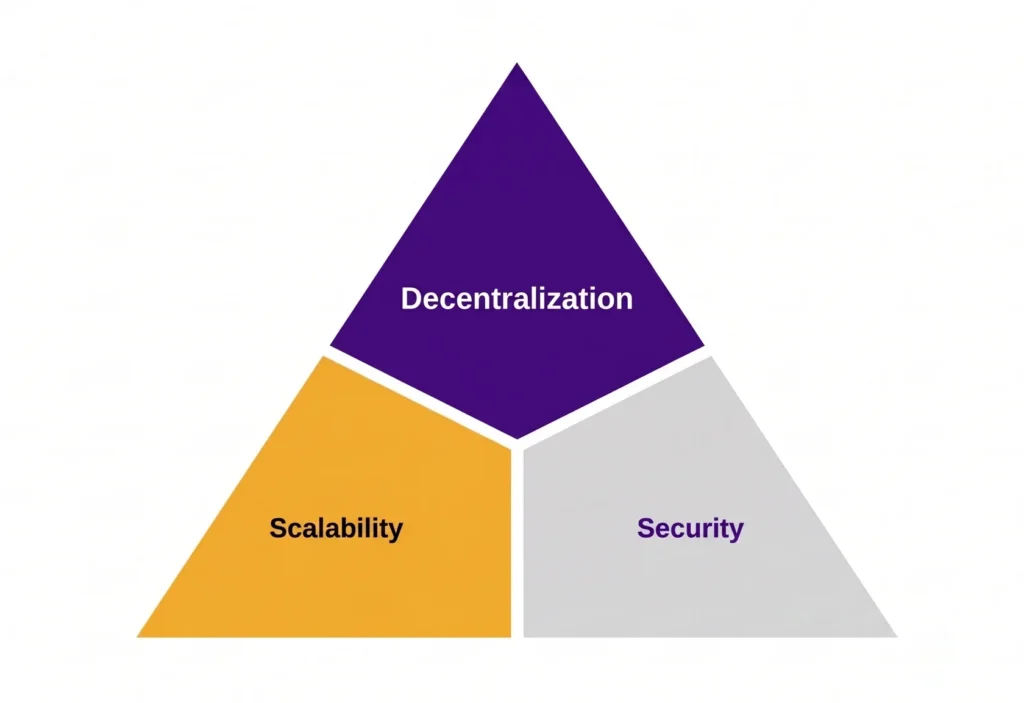
Core Identity: What is Arbitrum?
Arbitrum is a blockchain platform, primarily known for its Layer 2 (L2) scaling solution, Arbitrum One, built on top of the Ethereum blockchain and designed to tackle the trilemma of balancing security, scalability, and decentralization. The primary goal of an L2 is to provide a high-throughput environment where users can enjoy significantly lower transaction fees and near-instant confirmations without losing the robust security guarantees of, in Arbitrum’s case, the Ethereum mainnet. By operating as an optimistic “rollup,” Arbitrum handles the heavy lifting of transaction execution away from Ethereum’s main chain, then periodically bundles those transactions and sends that data to be recorded on the main Ethereum chain. This batching reduces transaction fees due to the compression, and decreases processing time due to not operating within the Ethereum block cycle. This treats Ethereum like a settlement layer instead of a computation layer, resulting in gas fees remaining 90-95% lower than Ethereum mainnet equivalents. Bitcoin’s L2s can’t replicate this functionality because Bitcoin’s base-layer scripting language is intentionally limited – meaning its L2s require different trust models like its Lightning Network.
What makes Arbitrum’s architecture particularly compelling from a business perspective is the economic model of fee revenue from processed transactions. Once the infrastructure is in place, the marginal cost of processing additional transactions is negligible – the protocol operates with an estimated gross margin of 90%. This profitability is a distinct advantage over L1 networks; while L1s must continuously subsidize their validators and stakers through inflation to maintain the network, L2s operate without this massive capital expenditure because they inherit their security directly from Ethereum.
Consequently, these exceptionally high margins accrue directly to the tokenholder-governed ArbitrumDAO treasury (a “decentralized autonomous organization” or “DAO”), rather than passing through a centralized operating entity or foundation. The network has also begun to move away from dependence on sequencer revenue – fees generated by controlling the order of transactions – as its primary income source. This structure mirrors some aspects of traditional finance and cloud computing structures: the underlying asset captures a small percentage of every transaction that flows through it. As transaction volumes scale with minimal additional marginal cost, the DAO can aggressively reinvest its treasury capital into growth opportunities, such as the STEP investment program. This creates a significant compounding flywheel effect, driving further ecosystem adoption while Arbitrum acts as the underlying service provider running the infrastructure and technology platform.
Critically, L2 scaling alone doesn’t solve enterprise needs – institutions want stack customization, to be landlords rather than renters. This is where the Arbitrum model extends beyond a single network: teams can launch on the shared liquidity of Arbitrum One, then migrate to a dedicated chain built on the same stack as they mature. It is exactly the path Robinhood took.
Protocol Adoption
According to RWA.xyz, the vast majority of Real-World Asset (RWA) value is accruing in tokenized US Treasury debt (over $15.1 billion) and commodities ($4.6 billion), which together account for more than half of the $33.8 billion total market cap.
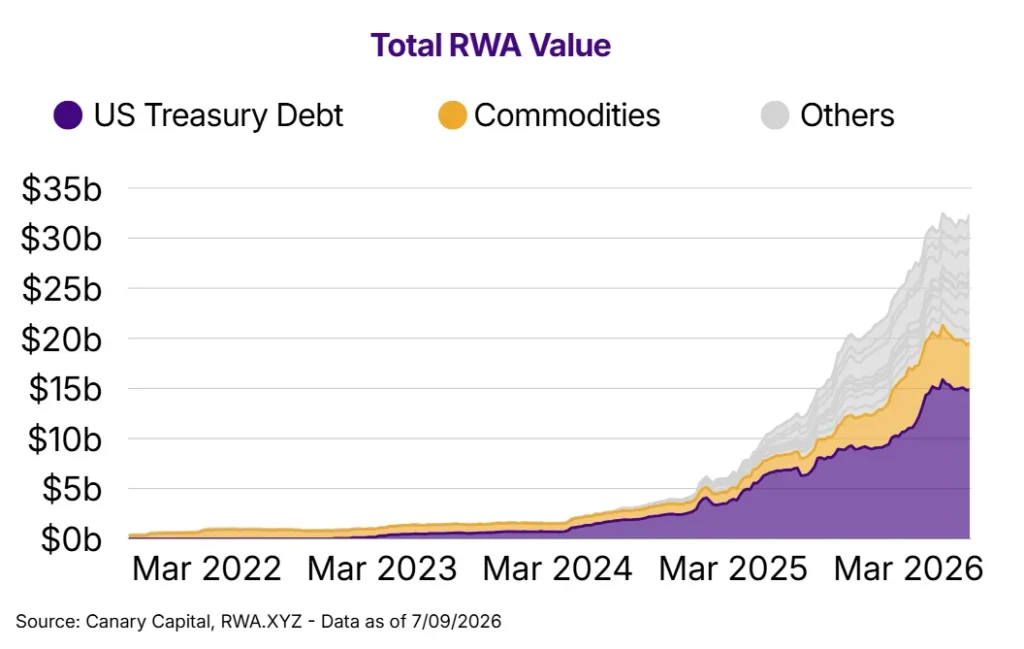
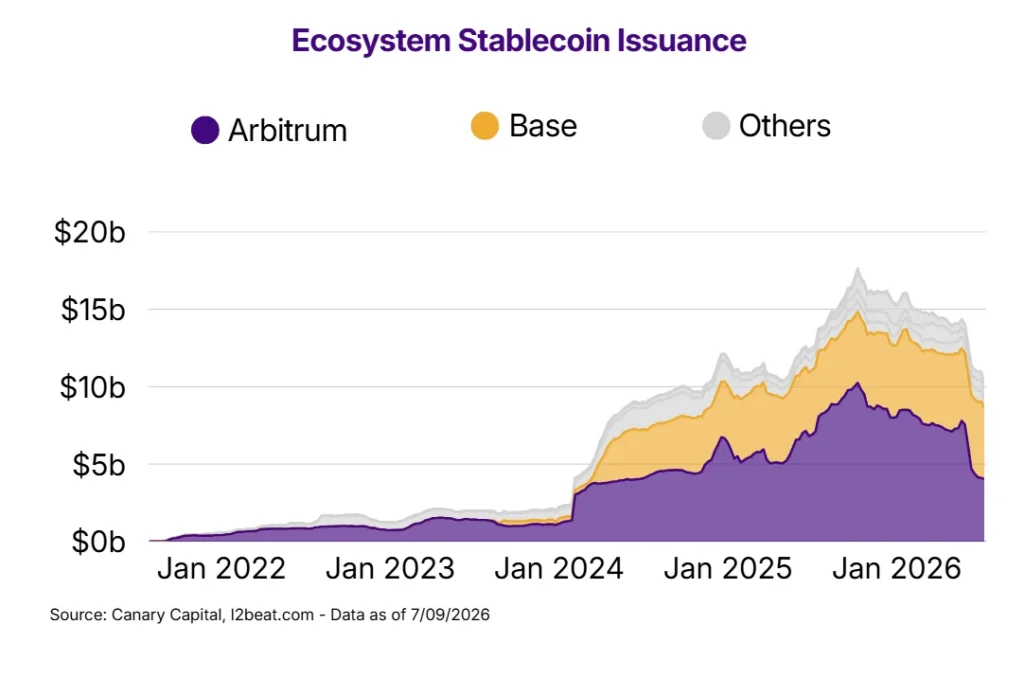
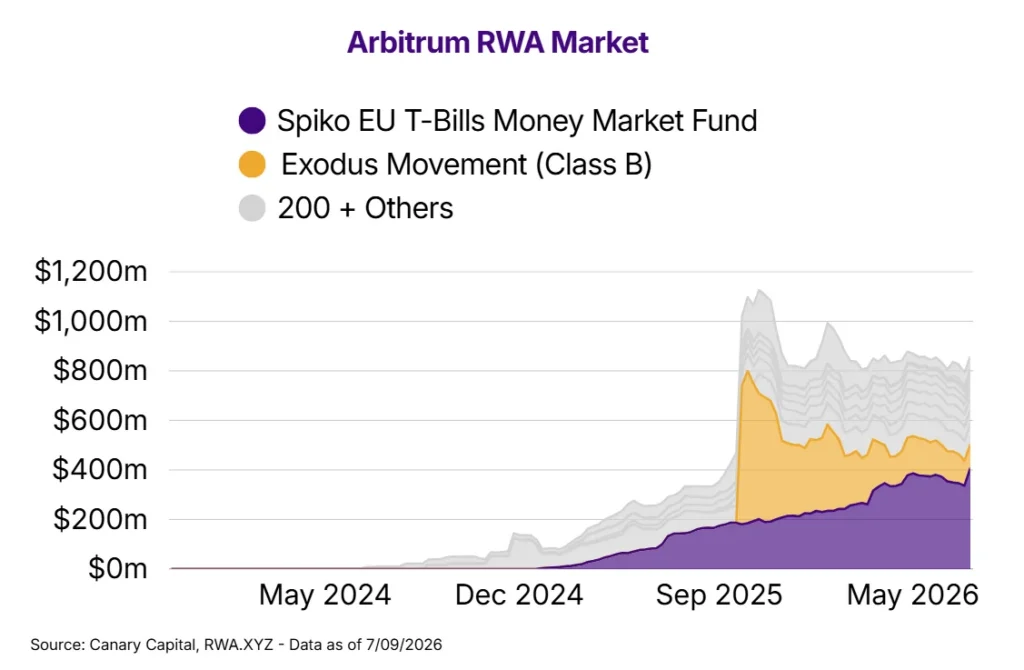
This heavy concentration is primarily driven by strong demand for low-risk, reliable yields among crypto-native investors and decentralized finance (DeFi) protocols. Demand for this asset class is rising as Spiko – which launched the world’s first fully regulated tokenized money market funds in 2024 and specializes in tokenizing US and Euro Treasury bills – became the largest RWA issuer on Arbitrum, reaching $400M TVL in July 2026. This marks the development of a more sophisticated pool of capital within the crypto ecosystem, moving beyond memecoins and other speculative investments into models that fit more traditional finance appetites. In a relatively high-interest-rate macroeconomic environment, tokenized Treasuries provide a highly attractive utility: they allow market participants to capture government yields directly on-chain rather than holding non-yielding stablecoins. However, despite being non-yielding, stablecoins themselves have utility – they serve as the primary liquidity layer in DeFi by acting as price-stable collateral for lending and a base trading pair on exchanges, while L2 networks leverage them to provide high-speed, low-cost settlement for retail payments and cross-border remittances. L2s have seen rapid growth in stablecoin deployment on their protocols, with Arbitrum holding the largest share of any L2. Arbitrum’s position in the RWA market itself follows the same pattern: the network now leads all chains in tokenized asset count per RWA.xyz, having served as an early home for BlackRock, Franklin Templeton, and WisdomTree products – adoption which the DAO actively seeded through its STEP treasury program.
RWA Transfer volume has seen similar growth over the last several years. However, it is more heavily concentrated in Asset-Backed Credit and Commodities, which together drive the massive transaction spikes exceeding $10 billion per week in late 2025 and early 2026. While US Treasuries dominate total market value as a passive asset for yield, they represent a much smaller fraction of daily movement. Asset-Backed Credit naturally generates high transfer volumes because the underlying mechanics involve the continuous issuance, structuring, and repayment of loans, invoices, and receivables. Similarly, tokenized commodities are highly liquid assets that are actively traded for inflation hedging, arbitrage, or used as rapidly moving collateral within dynamic DeFi protocols, resulting in a significantly higher turnover rate and velocity than government debt. This generates greater transactional volume on the blockchain, and as a result, greater revenue for the underlying issuing network like Arbitrum.
Robinhood Integration
The Robinhood-Arbitrum partnership has evolved from a product deployment into dedicated settlement infrastructure. In June 2025, Robinhood launched Stock Tokens on Arbitrum One, allowing European users to trade over 2,000 tokenized US equities and ETFs 24/7. On July 1, 2026, the relationship reached its next stage with the public mainnet launch of Robinhood Chain: a dedicated Layer 2 built on the Arbitrum technology stack that settles directly to Ethereum. The chain runs at 100-millisecond latency, compared to ~400ms on Solana, uses ETH as its gas token, and arrived five months after a public testnet that processed more than 200 million transactions. Because the chain settles to Ethereum rather than to Arbitrum One, it falls within the scope of the Arbitrum Expansion Program license – 10% of net protocol revenue returns to the ecosystem.
The first two weeks of public mainnet have shown strong adoption and market participation. Cumulative transactions crossed 49 million, with daily throughput peaking above 10 million transactions.
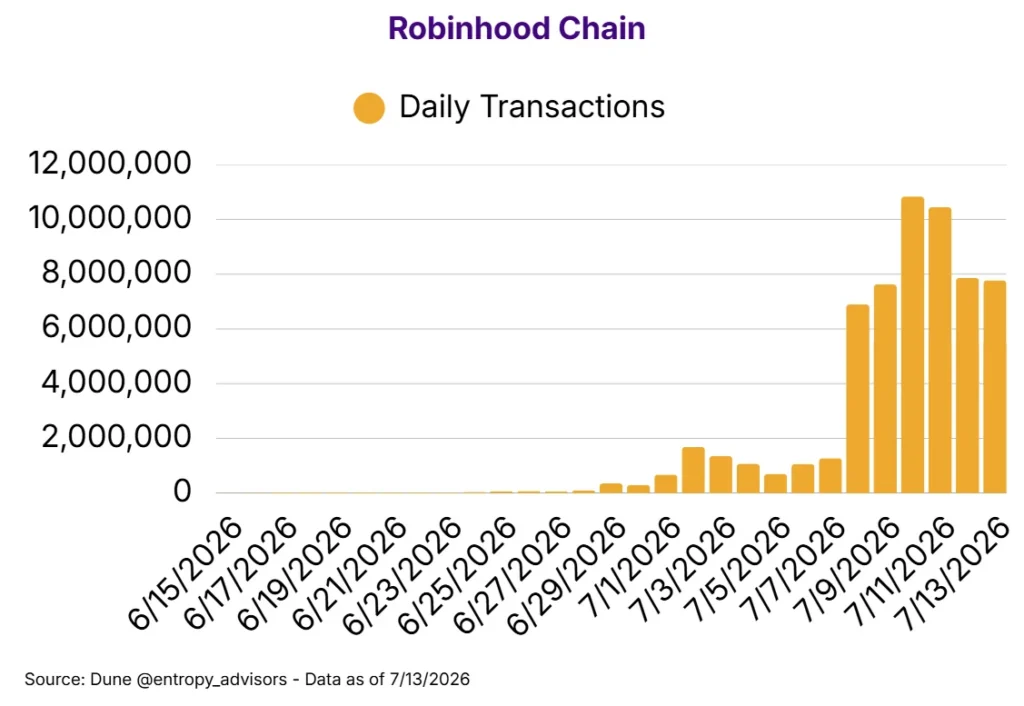
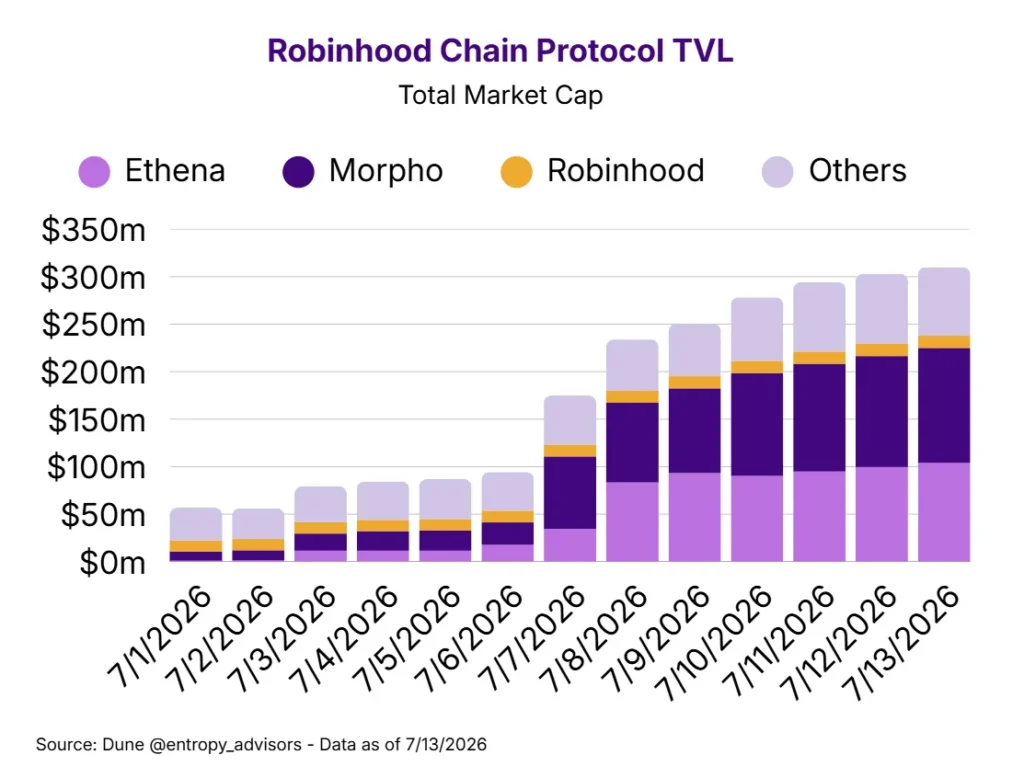
Capital formation followed the same trajectory: total value bridged to the chain grew from $6.6 million on launch day to $149 million by July 13. The single largest move – $88.7 million of net inflows on July 8 alone – is consistent with the phased rollout of Robinhood Earn, an on-chain dollar lending product powered by Morpho. TVL across the chain’s DeFi protocols reached approximately $310 million, led by Morpho ($121.0M) and Ethena ($104.0M), the lending and synthetic-dollar layers underneath Earn, and Robinhood’s own contracts ($12.9M).
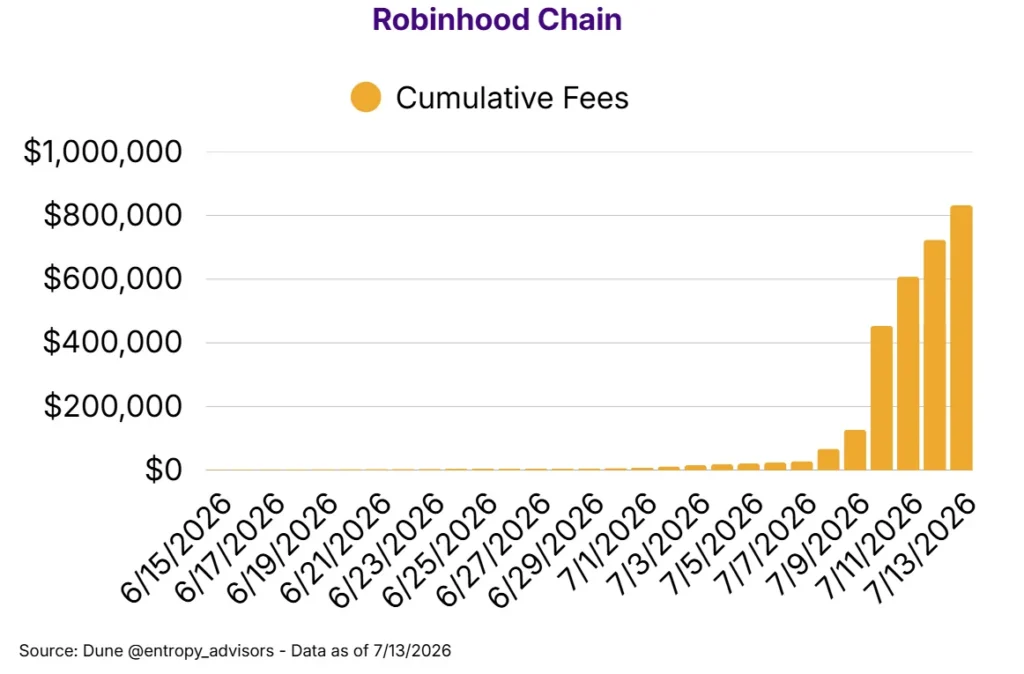
The fee data, while early, shows strong margins in a stable range above 99%. The chain generated roughly $831,000 in transaction fees over its first two weeks, against Ethereum L1 transaction costs that round to zero – with average transaction fees peaking at 3 cents even on days when 10 million transactions were processed.
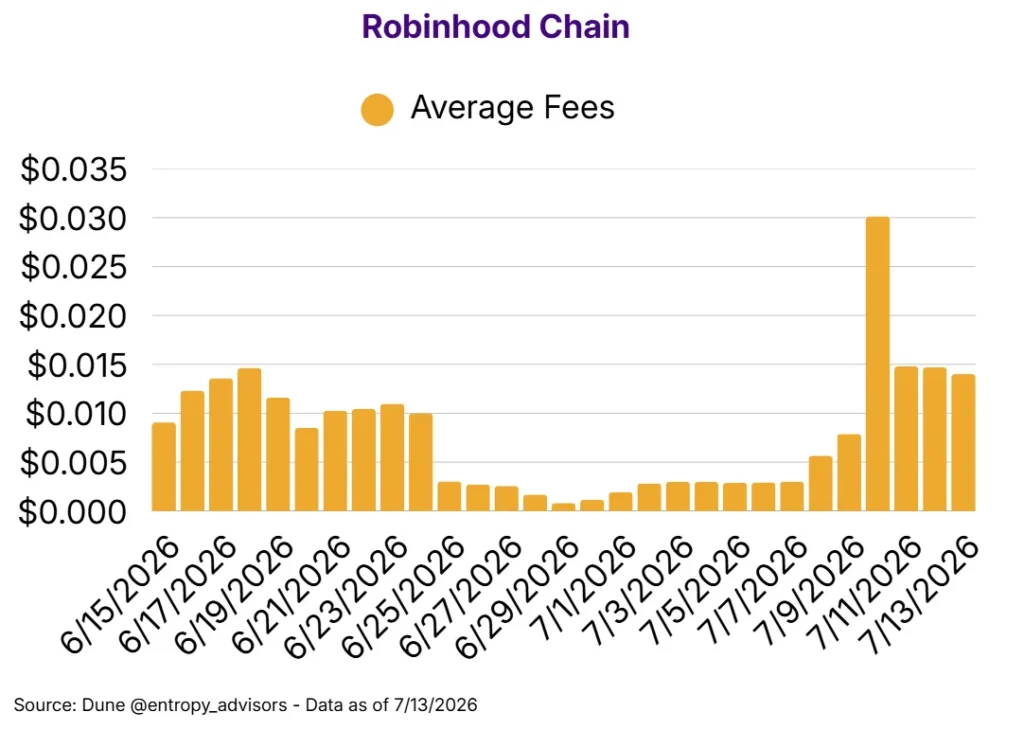
In absolute terms this is modest: at the current run rate, annualized fee revenue sits in the double-digit millions; the Arbitrum ecosystem captures 10% of the chain’s net protocol revenue. However, every transaction on Robinhood Chain now carries an automatic royalty back to the Arbitrum ecosystem, the revenue line scales with Robinhood’s on-chain volume at no incremental cost to the DAO, and the launch establishes the template the Arbitrum Expansion Program was designed for: each institutional chain deployment adding a license line that accrues value back to the DAO.
This volume is increasingly relevant due to the widening regulatory scope. In March 2026, the SEC approved Nasdaq’s proposal to trade tokenized versions of Russell 1000 stocks and major index ETFs through the DTC’s tokenization pilot, with the first token-settled trades expected in the second half of the year. The Robinhood-Arbitrum model demonstrates the deeper version of that same integration: a brokerage operating its own settlement layer, where end users transact against tokenized assets without necessarily realizing their activity settles on-chain. If retail brokerages continue expanding into tokenized assets, the primary impact on the L2s beneath them accrues through distribution – user access, cross-chain launches, swaps, and bridging – with the network operating as the invisible base infrastructure.
Recent Evolution
Expanding out to the broader Arbitrum ecosystem, the Arbitrum Foundation’s 2025 Transparency Report showed that the network’s RWA market cap reached over $1 billion in 2025, driven by a 7x year-over-year increase in tokenized financial products. This expansion is anchored by major players like Spiko, which leads with its EU T-Bills Money Market Fund, and Franklin Templeton, which expanded its Benji (FOBXX) platform to Arbitrum in late 2024 with U.S. Government Money Market Funds.
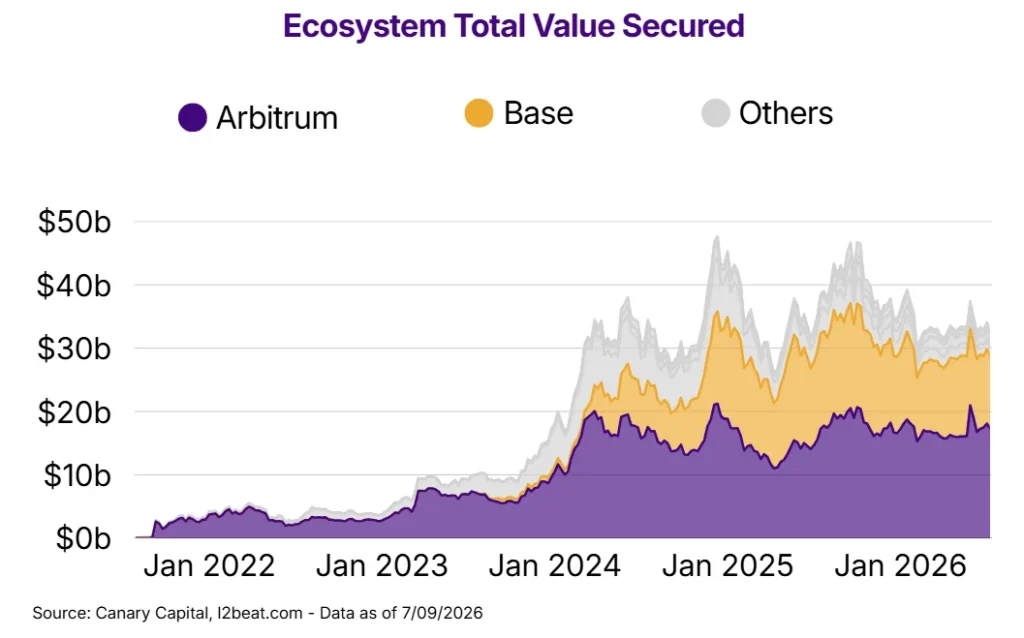
To date, the network has crossed the milestone of 2.7 billion lifetime transactions, with the second billion being processed in less than 12 months. Total Value Secured (TVS) climbed to a peak of approximately $20 billion with Arbitrum holding a consistent #1 rank in TVS market share, while sector-wide L2 TVS climbed above $40 billion in 2025. TVS is a broader metric than Total Value Locked (TVL), measuring the total value that depends on a network’s security guarantees, including bridged assets, L2 settlements, or applications relying on the chain.
Financing The DAO
The ArbitrumDAO has matured from a single-revenue protocol into a diversified financial operation. By year-end 2025, the DAO generated revenue from four distinct sources: transaction fees, Timeboost sequencing auctions, treasury management returns, and the Arbitrum Expansion Program. Timeboost, the newest of these streams, warrants a closer look.
Launched in April 2025, it replaces the network’s first-come-first-served transaction ordering with a recurring auction for an “express lane” – sophisticated traders bid for a temporary time advantage rather than investing in hardware to win latency races – allowing the protocol to capture MEV that would otherwise accrue entirely to searchers, while the private mempool continues to protect users from front-running and sandwich attacks. The mechanism generated over $6 million in its first year, with 97% of proceeds flowing to the DAO, and while its run rate has softened alongside broader market activity, it still contributes roughly a quarter of total DAO income.
However, monthly income figures reveal that protocol revenue has declined significantly from its peak of roughly $10 million per month in late 2023 and early 2024. Critically, this decline reflects pricing, not demand: the Dencun upgrade (EIP-4844) in March 2024 collapsed data-posting costs across all L2s, cutting per-transaction fees by design – a change Arbitrum actively welcomed on the thesis that cheaper blockspace drives greater volume over time. That thesis has held; transaction counts have grown substantially since, with the network’s second billion transactions processed in under twelve months. The $23.49 million gross profit figure for 2025 is best understood as protocol-level margin – fee revenue net of sequencer costs – rather than a reflection of total DAO net income. Sequencer costs alone represent approximately 26% of all cumulative DAO expenditures, forming a persistent and substantial base cost that sits below the gross profit line.
On a cumulative basis, the DAO’s expenses have significantly outpaced its earned income, with the gap widening to over $200 million as of early 2026. The dominant driver is incentive spending, which accounts for nearly 60% of all historical expenditures since the DAO’s inception. This spending consists of: grants, liquidity programs, and ecosystem rewards that the DAO has deployed to bootstrap adoption. This is a deliberate growth-over-profitability posture as the DAO retains a treasury of roughly 2.66 billion ARB (~$240 million), alongside ~$100 million in non-native assets – cash equivalents, ETH and liquid staking tokens, and other assets – a diversification that provides runway independent of the ARB price itself. Critically, the more recent monthly income-versus-expense data shows the gap narrowing, with the DAO trending toward operational sustainability as incentive programs mature.
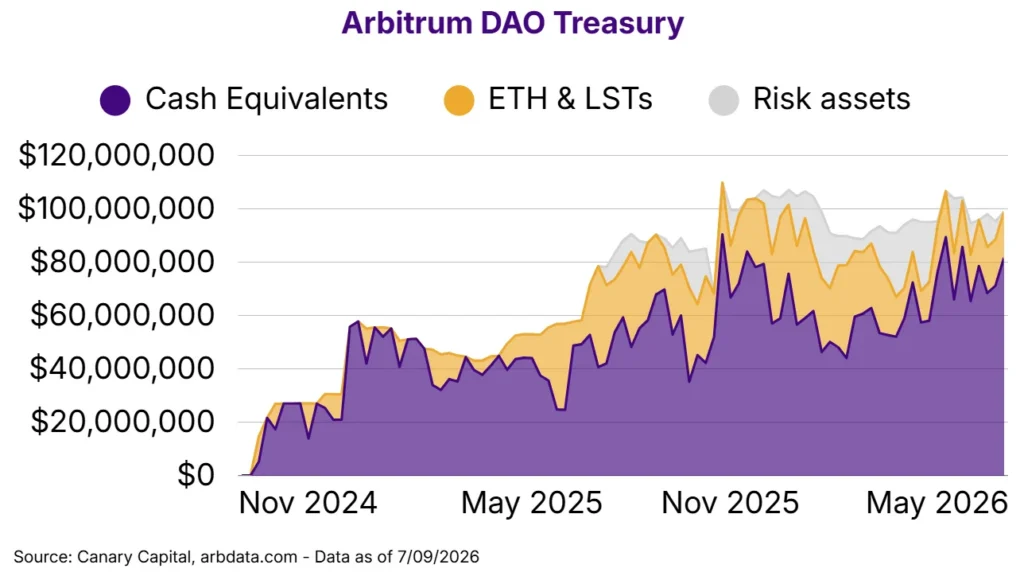
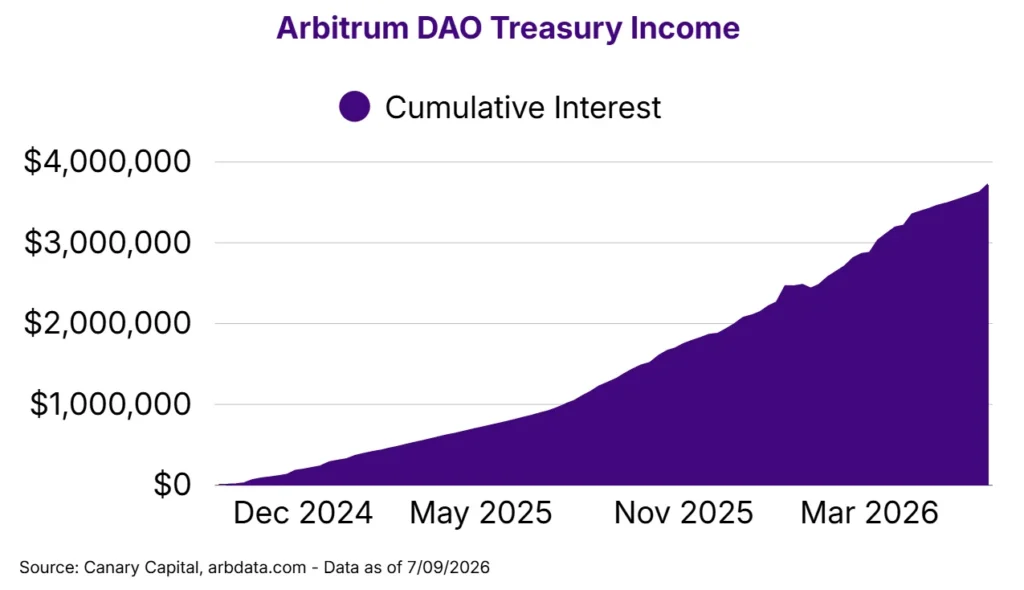
On treasury management, the DAO launched a program deploying treasury capital into yield-bearing instruments – allocating 35 million ARB across Franklin Templeton, Spiko, and WisdomTree – representing a viable product-market fit for RWA usage by DAOs and other organizations seeking return on capital from their treasuries. The DAO has also engaged in Ethereum covered call strategies to generate income. To date, these activities have yielded $3.75 million, with an average 30D APY of 3.53%.
The Path Forward
The ecosystem has focused heavily on RWAs and infrastructure decentralization. The Arbitrum DAO’s STEP investment program successfully channeled millions into yield-bearing instruments, attracting major asset managers like Franklin Templeton and WisdomTree to expand their tokenized products on-chain. On the technical side, the last 12 months saw the mainnet launch of BoLD (Bounded Liquidity Delay), a protocol that enables permissionless validation, and Arbitrum Stylus, which allows developers to write smart contracts in more common programming languages.
Arbitrum’s evolution reflects a broader structural shift in blockchain architecture – from isolated, retail-driven ecosystems to deeply integrated financial infrastructure capable of supporting institutional-scale activity. By pairing technical innovations and permissionless validation with institutional partnerships, the network is building the infrastructure to interconnect traditional brokerage with decentralized infrastructure. As the tokenization of real-world assets accelerates, Arbitrum’s focus on high-performance, neutral infrastructure positions it to serve as the secure backend powering this next generation of capital markets.
Concepts
- Layer 1 (L1): The foundational base-level blockchain architecture, such as Ethereum, that handles primary security and transaction validation.
- Layer 2 (L2): A scaling solution built on top of an L1 that executes transactions off the L1 execution layer while leveraging L1 for settlement, data availability, and security guarantees.
- Gas War: A competitive situation where users significantly increase transaction fees to outbid others for priority processing during high network demand.
- Rollup: A scaling strategy that executes transactions off-chain, bundles them together, and posts the compressed data back to the main ledger.
- Total Value Locked (TVL): A metric representing the total fiat value of all digital assets currently deposited in a blockchain’s smart contracts.
- Total Value Secured (TVS): A broad metric measuring the total value that depends on a network’s security guarantees, including bridged assets, L2 settlements, or applications relying on the chain.
- Real-World Assets (RWA): Tokenized representations of off-chain assets (e.g., treasuries, real estate, commodities) that derive value from legal or financial claims in the traditional system.
- Optimistic Rollup: A scaling method that assumes transactions are valid by default to provide instant speed, with correctness enforced via fraud proofs during a challenge window.
- Fraud Proof: A security mechanism that allows network participants to challenge and revert incorrect or malicious transaction data during a specific window.
- BoLD (Bounded Liquidity Delay): A dispute resolution upgrade for Arbitrum that guarantees fraud proofs resolve within a fixed time bound, enabling fully permissionless validation without risk of indefinite delays.
- GENIUS Act of 2025: The first comprehensive US regulatory and licensing framework for payment stablecoins – the legislation governing dollar tokens that provide on-chain settlement liquidity.
Sources
- https://robinhood.com/us/en/newsroom/robinhood-accelerates-global-expansion-robinhood-chain-mainnet-stock-tokens-agentic-trading/
- https://www.theblock.co/post/390440/robinhood-l2-testnet-four-million
- https://blog.arbitrum.foundation/the-arbitrum-foundation-2025-transparency-report-the-year-of-institutional-adoption/
- https://www.dlnews.com/articles/defi/arbitrum-gets-3m-revenue-bump-from-timeboost/
- https://www.theblock.co/post/340278/offchain-labs-releases-arbitrum-bold-on-mainnet-for-permissionless-validation
- https://robinhood.com/us/en/newsroom/robinhood-launches-stock-tokens-reveals-layer-2-blockchain-and-expands-crypto-suite-in-eu-and-us-with-perpetual-futures-and-staking/
- https://www.spiko.io/blog/spiko-launches-the-worlds-first-tokenized-money-market-funds
- https://www.theblock.co/post/353631/arbitrum-dao-us-treasurys
- https://www.coindesk.com/policy/2026/03/18/sec-approves-nasdaq-s-move-to-allow-tokenized-securities-trading
- https://blog.arbitrum.foundation/arbitrum-in-2025-the-year-of-everywhere/
- https://messari.io/report/arbitrum-everywhere-beyond-the-limits
- https://app.artemisanalytics.com/home
- https://app.rwa.xyz/
- https://dune.com/entropy_advisors/arbitrum-dao-financials
- https://dune.com/entropy_advisors/robinhood-chain-network-overview
- https://arbdata.com/
- https://docs.arbitrum.io/launch-arbitrum-chain/chain-config/costs/aep-overview
- https://tokenterminal.com/explorer/projects/arbitrum/metrics/transaction-count?interval=max&granularity=month
- https://forum.arbitrum.foundation/t/arbitrumdao-factsheet-robinhood-chain-mainnet-launch/31041
- https://thedefiant.io/news/blockchains/arbitrum-foundation-seeks-usd45m-funding-as-delegates-question-spending-above-dao-revenue