

A high-throughput, object-centric layer-1 designed for scalable, consumer-grade Web3 applications
Sui Network Overview
The Sui (SUI) network is a delegated Proof-of-Stake (PoS) Layer-1 blockchain developed starting in 2021, with a token generation event (TGE) in April 2023 and a mainnet launch in May 20231. Sui is built around an object-oriented data model and parallel transaction execution, enabling high throughput, low latency, and strong scalability. This architecture makes it well suited for consumer applications, gaming, and complex digital assets in the Web3 environment. The SUI token is used to pay for network services and transaction fees, secure the network through staking, and support applications built on the Sui ecosystem2.
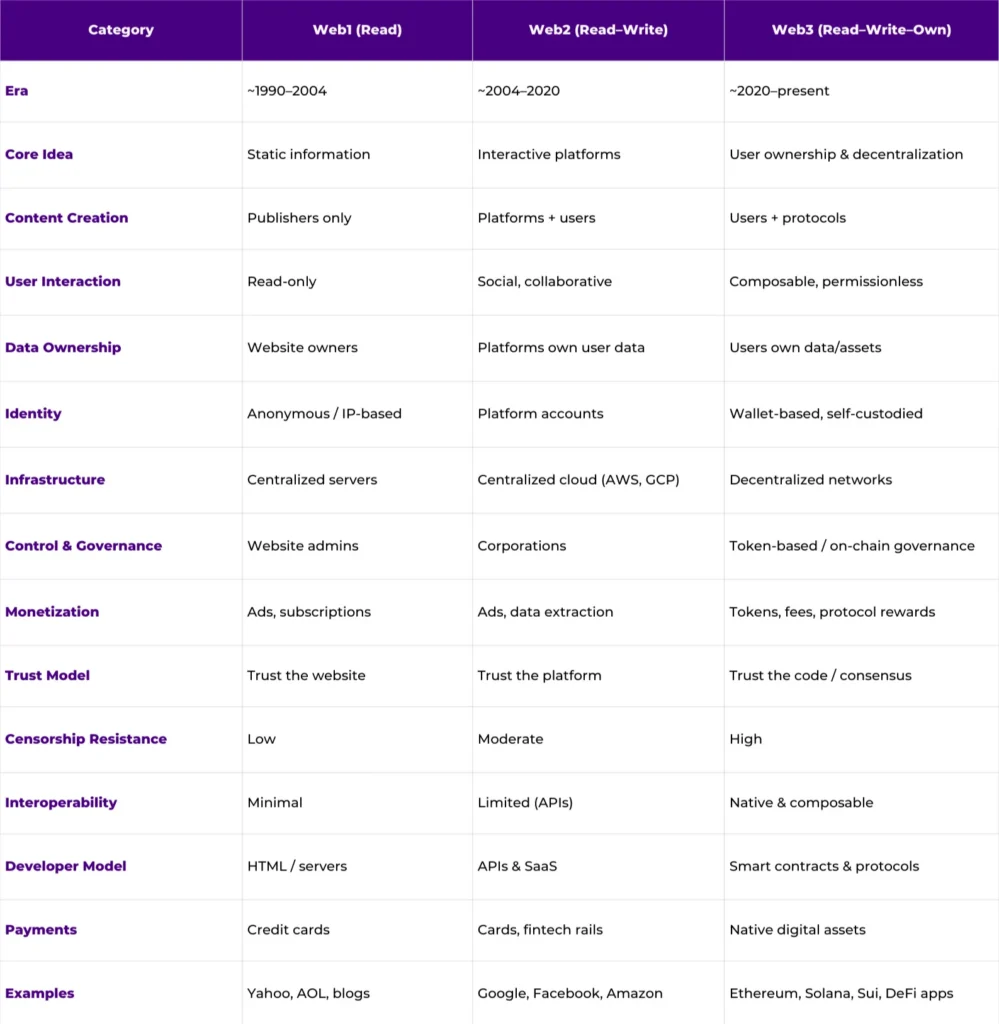
- Web1: Information online
- Web2: Platforms and social interaction
- Web3: Ownership, composability, and programmable value
Founders, Goals and Network Architecture
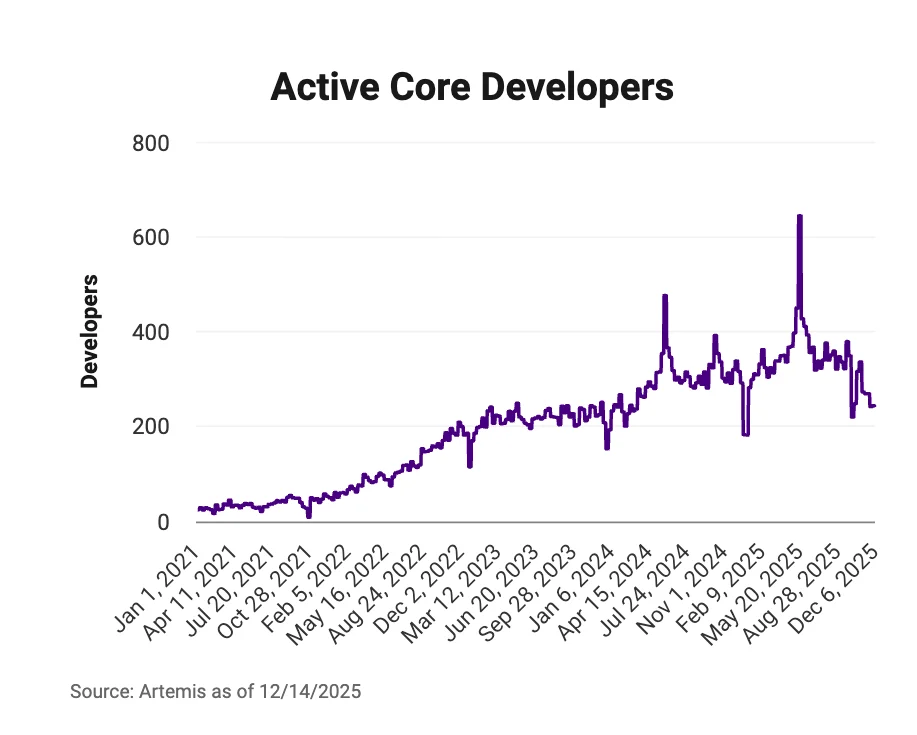
Development started through Mysten Labs using the Move programming language, which built on the team’s experience at Meta’s Diem3. Mysten Labs engineers included Evan Cheng as CEO, Sam Blackshear as CTO, Adeniyi Abiodun as CPO, George Danezis as chief scientist, and Kostas Chalkias as cryptography lead. Move on Sui, which was created by Blackshear, offers enhanced flexibility and efficiency compared to other Web3 programming languages, allowing for parallel transaction processing. Core development has continued to see a rise in active developers since launch in 2021.
Sui’s foundational infrastructure, Sui Stack, is a modular framework of storage, compute, and data services designed for building verifiable, composable, and user-centric applications. The stack of protocols and services includes:
Sui – Execution Layer
- High-throughput smart contracts and shared state logic – ideal for asset-centric workflows, from DeFi and payments to cross-app coordination.
- Fast, composable, and optimized not just for finance, but for the next generation of real-world apps.
Walrus
- Decentralized, verifiable data storage for files, logs, datasets, and models.
- Supports content-based addressing and cryptographic integrity – so users can own data, and apps can reference it without relying on centralized storage providers.
Walrus Sites
- Decentralized frontends – served directly from Walrus.
- Secure, content-addressed UI deployments with cryptographic guarantees.
- A verifiable alternative to Netlify or Vercel that gives you frontend and backend alignment and removes central points of failure.
Seal
- Programmable encryption + access control.
- Define policies on-chain and protect data using threshold cryptography.
- Designed for:
- Subscription or token-gated access
- Private docs and messaging
- Licensed data sharing
- Seal enforces the logic – no centralized key server required.
Nautilus
- Confidential off-chain compute that proves what it did on-chain.
- Runs in Trusted Execution Environments (TEEs) and issues attestations to verify outcomes and enable Web3 hybrid apps.
- Designed for:
- Private model inference
- Secure business logic
- Federated data transforms
- No opaque backends and no rollups necessary.
Zero Knowledge (Zk) Login + Passkeys
- Ability to login without revealing underlying information or seed phrases.
- ZkLogin lets users sign in with Google/Apple and still generate wallet-compatible identities.
- Passkeys support biometric and passwordless login with biometric and passwordless login using FaceID, TouchID, or PIN.
SuiNS
- Human-readable naming for users and apps.
- Build identity layers that work across apps and let users bring reputation, access, and content with them – no platform lock-in.
SUI Network Consensus and Delegated Proof-of-Stake (DPoS)
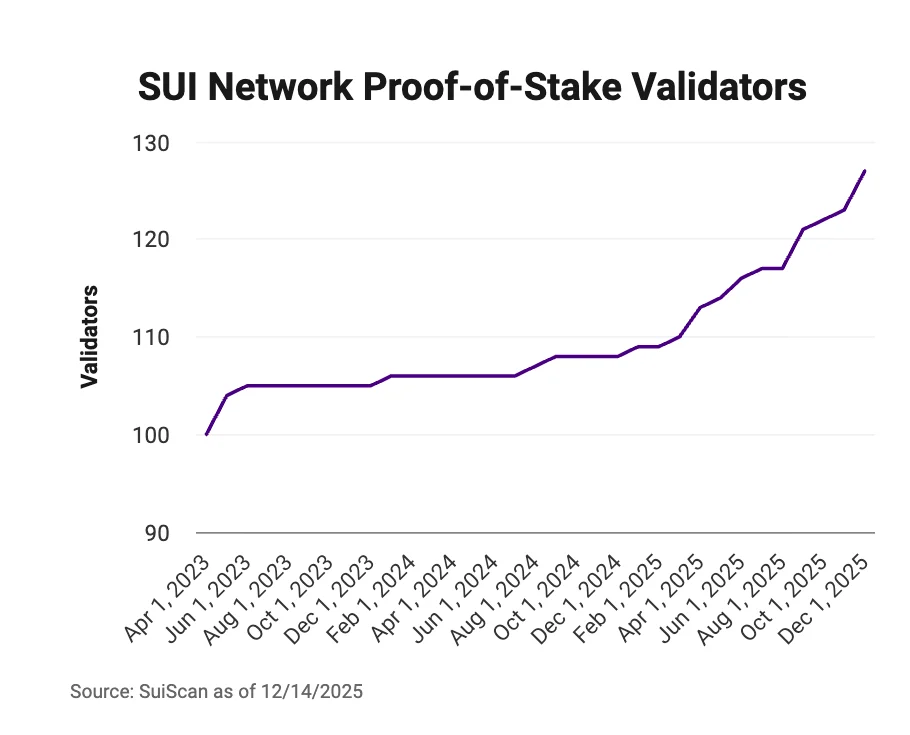
The Sui network uses a DPoS system where SUI token holders delegate stake to a fixed set of validators that produce and finalize transactions. To join the Sui validator set currently, a candidate must have at least 30 million SUI tokens delegated to it before the validator can be added to the active validator set on Mainnet.
Consensus is powered by Narwhal & Bullshark, a two-layer design: Narwhal handles efficient transaction data availability and ordering, while Bullshark finalizes blocks using a Byzantine Fault Tolerant (BFT) process3. This separation allows Sui to maintain fast finality and high throughput without requiring every transaction to go through full global consensus, which removes the main scalability bottleneck of traditional blockchains.
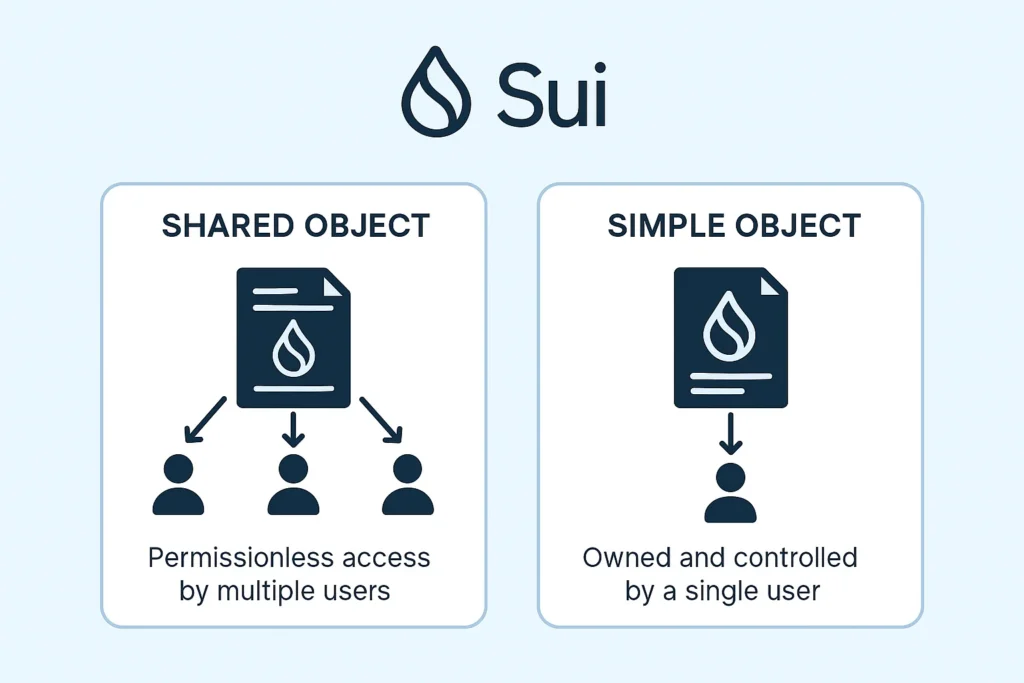
A key innovation in Sui is its distinction between simple objects and shared objects. Simple objects (also called owned objects) are owned by a single address and do not require global consensus to be updated. Because their ownership is unambiguous, validators can process these transactions independently and in parallel, which dramatically increases throughput and lowers latency. Most everyday actions, like transfers, mints, or inventory updates in games, fall into this category.
Shared objects, by contrast, can be accessed or modified by multiple users at the same time and do require consensus to ensure correctness. These objects are used for things like Decentralized Exchange (DEX) pools, marketplaces, or governance contracts where concurrent access must be coordinated. By limiting consensus only to shared-object transactions, Sui avoids unnecessary bottlenecks and achieves scalability by default, consensus is applied precisely where it’s needed, not everywhere.
Token Supply
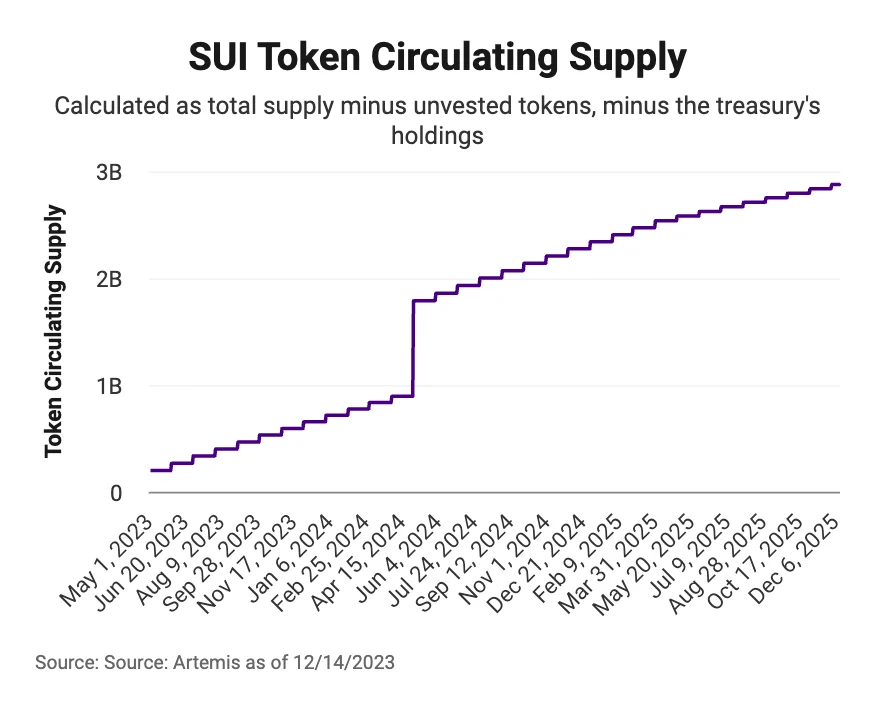
Sui has a fixed maximum supply of 10 billion SUI, defined at genesis and never inflationary beyond that cap4. At mainnet launch in 2023, only a small portion of that supply was circulating (roughly 6%), with the majority locked under long-term vesting. This design intentionally limited early float to reduce sell pressure while the network bootstrapped validators, applications, and real usage. New SUI tokens enter circulation over time primarily through vesting unlocks, not mining-style issuance.
The circulating supply increases gradually as tokens unlock across several buckets: community programs, staking rewards, ecosystem grants, early contributors, investors, and Mysten Labs. Staking rewards are paid from pre-allocated supply, not newly minted tokens, which means staking does not expand total supply, only redistributes it. As a result, Sui’s tokenomics are closer to a pre-mined, scheduled-release model than an inflationary PoS chain like Ethereum.
The vesting schedule is long-dated and staggered, with most non-circulating tokens unlocking over multiple years (generally 4–7 years depending on allocation). Early contributors and investors follow standard crypto vesting with cliffs and linear unlocks, while the community reserve is released more flexibly to fund ecosystem growth, incentives, and grants. This structure creates a tradeoff: near-term supply overhang from unlocks, but long-term predictability and no terminal inflation. For investors, Sui’s valuation dynamics are therefore driven less by issuance shocks and more by how quickly real network demand absorbs scheduled unlocks.
Network Activity
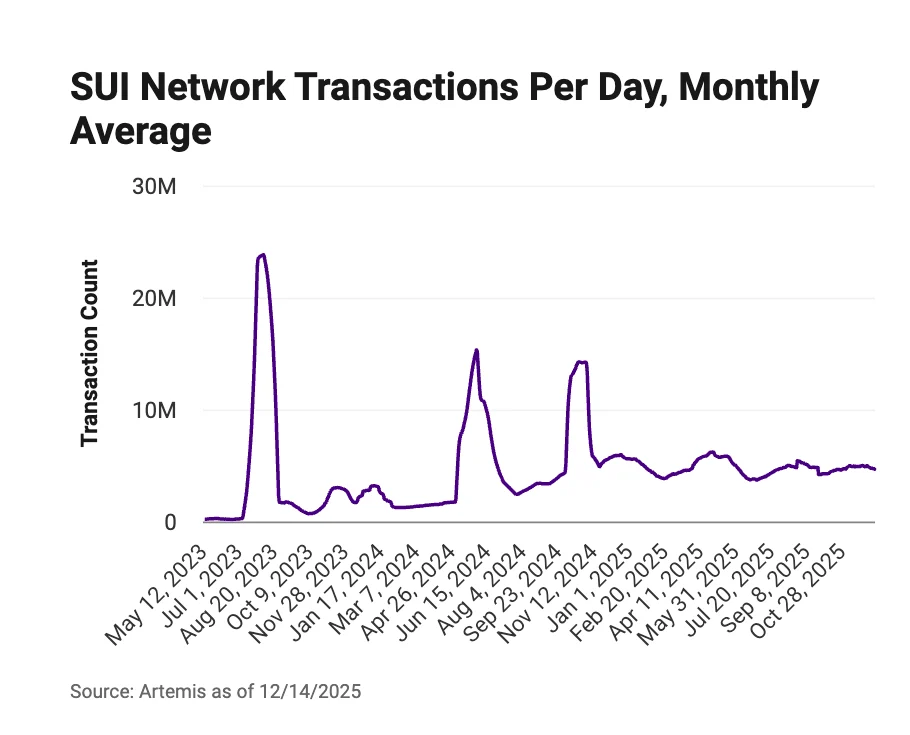
Network activity has shown gradual growth over time with transactions per day remaining in a tight range throughout 2025. Previous years also had episodic event-driven spikes in transaction count. Network fees, a measure of economic activity, have held steady since mid-2024.
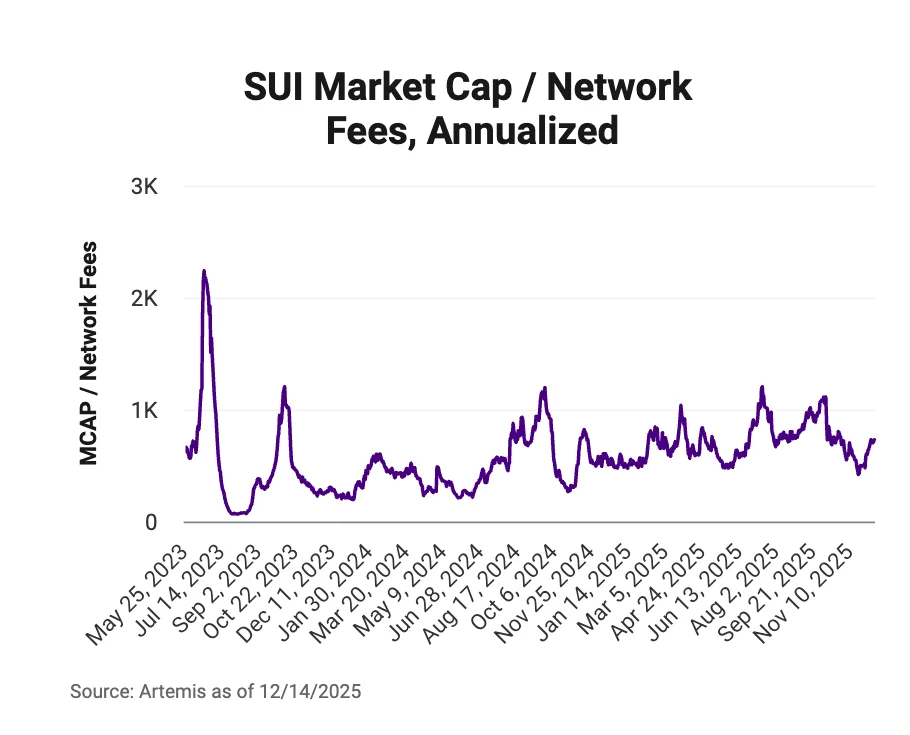
Market cap divided by fees is a valuation metric that can be understood as a crypto-native analog to the price-to-sales (P/S) ratio. In equities, P/S measures how much investors are paying for each dollar of a company’s revenue; here, market capitalization divided by annualized network fees shows how much the market is paying for each dollar of fee revenue generated by the Sui network. Like P/S, the multiple is driven primarily by expectations of future growth rather than current profitability. Elevated readings indicate that investors expect rapid increases in network activity, usage, or future monetization, while lower readings suggest either more modest growth expectations or that revenue is scaling faster than price.
As with early-stage or high-growth companies, this “network P/S” multiple should be interpreted with caution. Network fees are volatile, can be influenced by protocol parameters and subsidies, and do not represent revenue that directly accrues to token holders. As a result, the metric works best as a relative and directional tool rather than a valuation anchor. Compression in the ratio over time implies improving fundamentals as usage catches up to valuation, while expansion signals price appreciation running ahead of current fee generation. In practice, it is most informative when compared against the network’s own history or peer L1s and evaluated alongside adoption indicators such as transaction growth, active addresses, and fee growth rates.
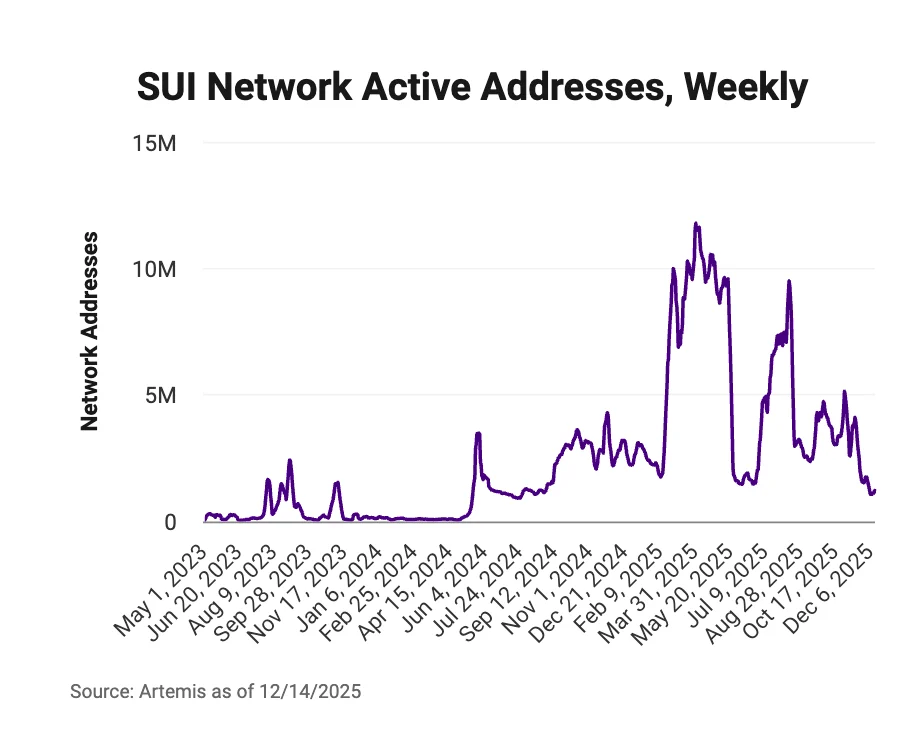
Active and unique addresses are key metrics for assessing a network’s fundamental value under Metcalfe’s Law, which holds that a network’s value is proportional to the square of its connected users (n²). Weekly active addresses (WAAs), which measure the number of unique wallet addresses that are active on a blockchain within a 7-day period, show a sharp spike in 2025, primarily driven by application-driven activity. Several high-throughput consumer apps and incentive-heavy programs such as gaming, social, trading, and quest-style campaigns.
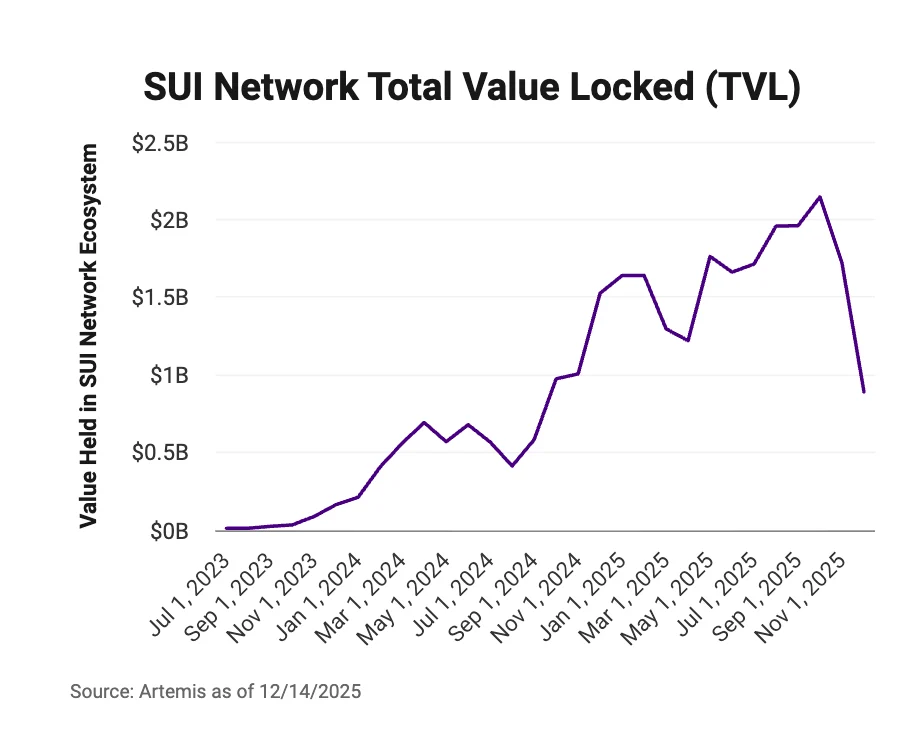
Total Value Locked (TVL) in Decentralized Finance (DeFi) is the total amount of cryptocurrency assets or USD deposited and “locked” in a protocol’s smart contracts, representing its size, liquidity, user trust, and overall health. Rising TVL suggests increased economic significance whereas falling TVL typically reflects a retrenchment in DeFi activity or a decline in underlying asset prices.
The surge in Sui’s TVL in 2024 and 2025 was driven by several fundamental and technical factors. The number of DeFi protocols on Sui grew, with platforms like Cetus, Bluefin, NAVI, Suilend, and Momentum attracting significant liquidity. The stablecoin ecosystem also expanded rapidly with the integration of major stablecoins like Circle’s USD Coin (USDC), Agora’s AUSD, First Digital USD (FDUSD), and Ondo US Dollar Yield (USDY), providing necessary liquidity and stability for DeFi operations.
Conclusion
The Sui Network is a Layer-1 blockchain that combines innovative architecture, object-oriented design, and parallel transaction processing to deliver high throughput, low latency, and scalable solutions for Web3 applications. Its delegated Proof-of-Stake consensus, powered by Narwhal and Bullshark, allows for efficient finality while limiting consensus to only shared-object transactions, reducing bottlenecks and improving performance. Coupled with a comprehensive developer stack, Sui enables secure, verifiable, and user-centric applications ranging from DeFi and gaming to private data sharing and decentralized identity. The network’s design emphasizes composability, privacy, and flexibility, positioning it as a strong platform for consumer-facing and complex digital applications in the Web3 ecosystem.
From a tokenomics and market perspective, SUI’s fixed supply and long-term vesting create predictable issuance, with staking rewards redistributed from pre-allocated tokens rather than inflating supply. Network activity metrics, including transaction counts, active addresses, fees, and TVL in DeFi, indicate steady growth and adoption, particularly driven by high-throughput consumer applications and incentive programs. When evaluated through crypto-native valuation frameworks such as network P/S ratios and Metcalfe’s Law, Sui demonstrates potential for sustained value creation as usage scales. Overall, Sui’s combination of technical innovation, developer tools, and robust economic design suggests a strong foundation for long-term adoption, positioning it as a competitive and versatile Layer-1 blockchain in the evolving Web3 landscape.
Risks & Disclosures
Sui is subject to unique and substantial risks, including significant price volatility and lack of liquidity and theft. Sui is subject to rapid price swings, including as a result of actions and statements by influencers and the media, changes in the supply of and demand for digital assets, and other factors. There is no guarantee that Sui will maintain its value over the long-term.
The statements, views, and opinions expressed herein are those of the Canary Capital Group LLC. The information presented is derived from sources the Firm believes to be reliable; however, the Firm makes no representation or warranty as to the accuracy, completeness, or timeliness of such information. The digital asset landscape is rapidly evolving, and information provided may change over time without notice.
Sources
- https://www.sec.gov/files/rules/sro/cboebzx/2025/34-102892.pdf
- https://www.cftc.gov/filings/ptc/ptc09292531389.pdf
- https://www.mystenlabs.com/platforms-and-protocols
- https://docs.sui.io/concepts/tokenomics
Glossary
API (Application Programming Interface)
A set of rules and protocols that allow different software applications to communicate and share data with one another.
AWS (Amazon Web Services)
A cloud computing platform offering on-demand services such as computing power, storage, databases, and networking.
DeFi (Decentralized Finance)
A blockchain-based financial system that removes intermediaries by using smart contracts to enable lending, trading, and other financial services.
GCP (Google Cloud Platform)
Google’s suite of cloud computing services providing infrastructure, data analytics, machine learning, and application development tools.
L1 Blockchain (Layer 1 Blockchain)
The base blockchain network responsible for security, consensus, and transaction settlement (e.g., Bitcoin, Ethereum).
Metcalfe’s Law
A principle stating that the value of a network grows proportionally to the square of the number of its connected users.
SaaS (Software as a Service)
A software delivery model where applications are hosted in the cloud and accessed via the internet, typically through a subscription.
UI (User Interface)
The visual and interactive elements through which users interact with software, including layouts, buttons, and navigation.
Web3
The next generation of the internet built on blockchain technology, emphasizing decentralization, user ownership, and trustless systems.