


Bitcoin Holds Ground Amid Oil Surge

KEY TAKEAWAYS
- Volatility persists as Middle East escalation has significantly spiked oil prices.
- Bitcoin holding the $65k–$70k level may signal short-term bearish exhaustion.
- Metcalfe’s Law suggests BTC price is nearing a discount relative to active addresses.
DIGITAL ASSET COMMENTARY
Risk assets continue to face pressure from escalating geopolitical tensions in the Middle East, which have driven a sharp spike in global oil prices. Late Sunday night, reports that several G7 nations may release barrels from their strategic petroleum reserves temporarily capped the roughly 30% surge in oil futures at the open. Until the conflict de-escalates and shipping lanes through the Strait of Hormuz are secured, elevated oil prices and equity volatility will likely remain the base case. Despite these macro headwinds, BTC appears to have found a temporary floor in the $65k–$70k range, potentially signaling short-term bearish exhaustion.
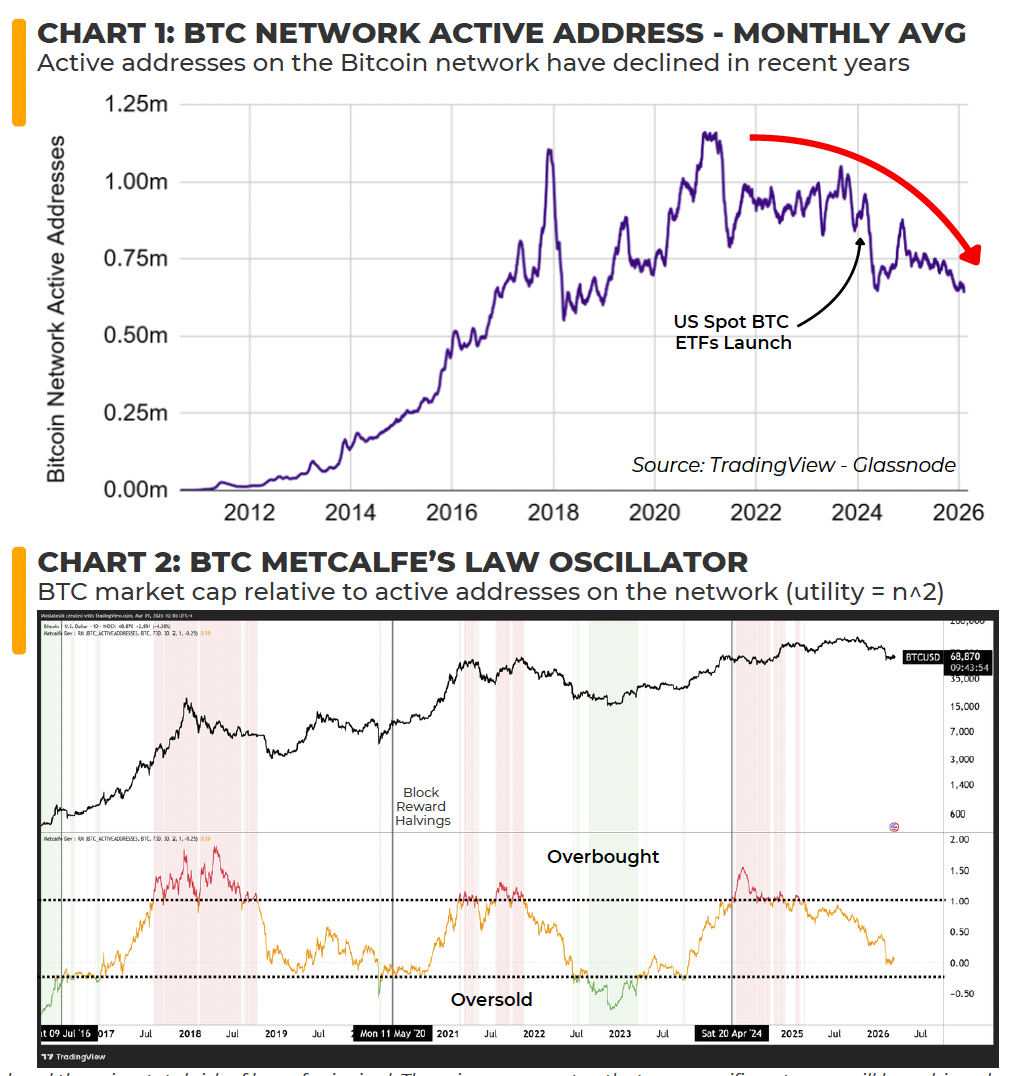
Applying traditional fundamental valuation frameworks to cryptocurrencies has always been difficult, but Metcalfe’s Law (ML) has historically provided some insight into overbought and oversold conditions in BTC. Metcalfe’s Law states that the value of a network is proportional to the square of its users. For BTC, active addresses (AA) are often used as a proxy for network participants.
BTC AAs peaked during the 2021 cycle and have gradually declined in the years since. The approval of U.S. spot BTC ETFs in 2024 likely contributed to this trend, as investors now have less need to interact directly with the blockchain. While ETF issuers still move coins in and out of custody, the ETF structure effectively acts as a secondary trading layer for BTC, allowing market participants to transact exposure while relying on the underlying network for settlement and security.
Using the ML framework today suggests BTC is trading at the lower bound of the fair value range relative to AA growth, with the ML metric currently hovering around zero. Historically, negative ML readings, where market value falls below the network’s implied value, have coincided with periods when BTC traded at a discount to network activity, often near cyclical bear-market lows


